

Deconstructing the Corporate Debt Engine: Structural Dynamics, Yield Mechanics, and Risk Immunization
For a corporate treasury department, securing capital is not merely an administrative event; it is a foundational strategic exercise that permanently shapes the enterprise's risk profile, cost of capital, and operational runway. While equity capital provides permanence at the expense of diluting ownership and commanding a high hurdle rate, the Debt Capital Markets (DCM) offer massive pools of non-dilutive liquidity.
However, entering the credit markets requires navigating a complex matrix of structural architectures, rigorous mathematical pricing models, and macroeconomic variables. Corporate borrowing reached record volumes, with global corporate debt issuance scaling to roughly $13.7 trillion. In this high-stakes landscape, corporate treasurers are operating under a "pragmatic omnicrisis" framework - viewing macroeconomic volatility, geopolitical friction, and shifting monetary policies not as exceptions, but as permanent structural realities embedded into balance sheet risk management.
1. The Architecture of Corporate Debt Packaging
When an enterprise resolves to raise debt capital, it faces a fundamental architectural choice between the public bond markets and the private credit ecosystem. This packaging decision dictates the maturity profile, liquidity requirements, pricing efficiency, and covenant restrictions placed upon the organization.
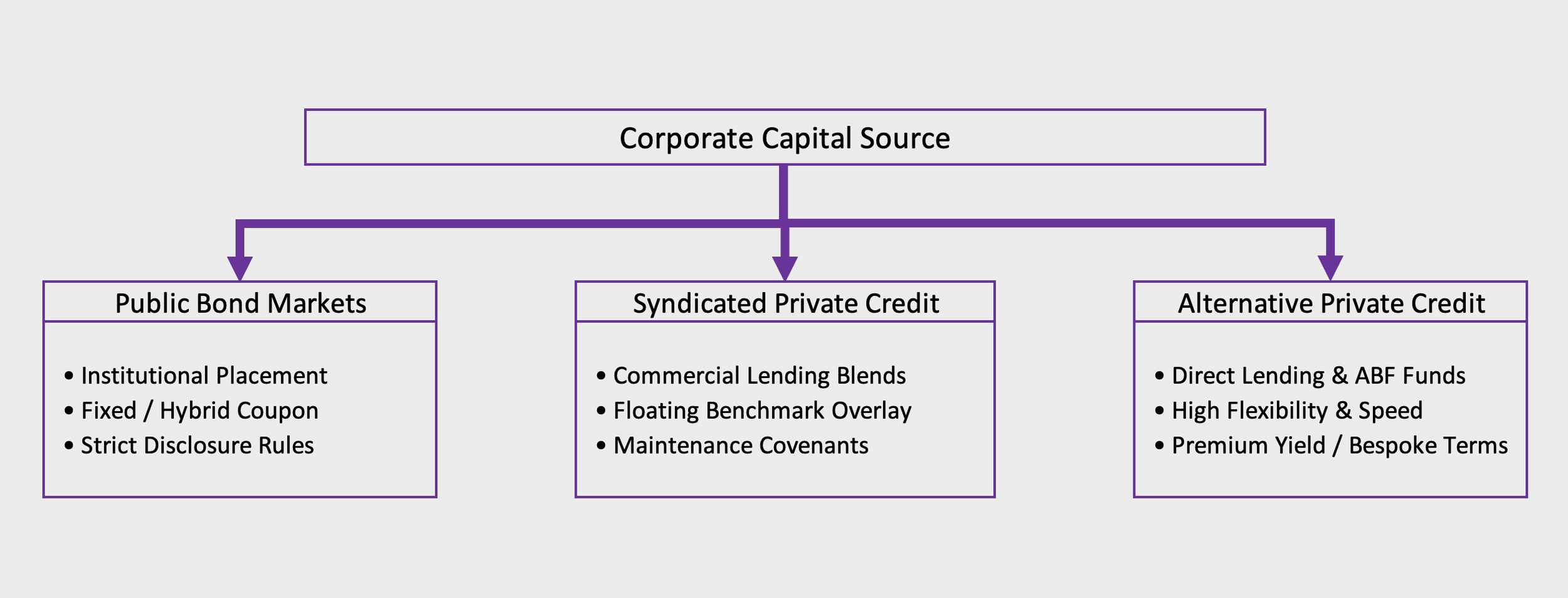
Sources of Corporate Capital
For large corporate issuers, the public bond market represents the pinnacle of financing scale. Issued under regulatory frameworks like SEC registration, Rule 144A placements, or European prospectus regimes, public bonds allow a company to borrow hundreds of millions directly from institutional investors such as pension funds, insurance companies, and asset managers.
Public bonds are typically structured with fixed coupon payments, bullet maturities (where the entire principal is repaid at the end of the term), and minimal structural interference. They offer maximum operational flexibility because they rarely include restrictive financial maintenance covenants. Instead, they rely on negative covenants (e.g., restrictions on creating liens or selling core assets) and are priced strictly off public credit ratings from agencies like S&P, Moody's, or Fitch.
To manage massive capital demands - such as financing the capital-intensive infrastructure outlays required for global Artificial Intelligence expansion - companies increasingly tap international bond pools. This has fueled a massive surge in "Reverse Yankee" issuances, where domestic US technology and industrial firms issue debt in foreign currencies like Euros to capture attractive cross-currency pricing and yield-spread differentials.
Syndicated Private Credit vs. Direct Lending
For companies requiring customized funding terms, rapid execution, or revolving facilities to manage working capital, the corporate banking market provides syndicated credit facilities. Rather than relying on a single lender, a lead arrangement bank pieces together a syndicate of multiple commercial financial institutions to fund a unified loan facility. Syndicated debt is highly structured, frequently relying on floating interest rates, amortizing principal repayments, and stringent financial maintenance covenants - such as mandatory leverage ratios (Net Debt/EBITDA) or interest coverage ratios (EBITDA/Interest Expense).
Simultaneously, the private debt ecosystem has expanded far beyond traditional commercial banks. Private Credit (PC) funds, sovereign wealth managers, and asset-backed finance (ABF) platforms provide direct lending solutions. While direct lending carries a yield premium, it offers rapid execution, absolute transaction certainty, and highly customized covenant structures. This creates a borrower-friendly environment where corporate treasurers actively mix public bonds, bank syndicates, and private direct debt to diversify their liquidity pipelines.
2. Yield Mechanics and Macroeconomic Benchmarks
The pricing of corporate debt is never determined in a vacuum. It is a mathematical function calculated by stacking a credit risk premium atop a dynamic macroeconomic foundation. Understanding this pricing architecture requires isolating the risk-free benchmark, the corporate credit spread, and the underlying shape of the yield curve.
The Pricing Stack
Every corporate debt instrument, whether a fixed-rate public bond or a floating-rate syndicated loan, is priced using a two-part equation:
Total Cost of Debt = Macroeconomic Benchmark + Corporate Credit Spread
The Macroeconomic Benchmark: This represents the theoretical risk-free rate of return for a given currency and time horizon. In the fixed-income market, this benchmark is driven by government bond yields (such as US Treasuries or German Bunds). In the floating-rate market, the benchmark is driven by backward-looking overnight risk-free reference indexes, primarily the Secured Overnight Financing Rate (SOFR) for US Dollars and the Euro Short-Term Rate (€STR) or EURIBOR for Euros.
The Corporate Credit Spread: This is the additional yield demanded by institutional investors to compensate them for the default risk, liquidity constraints, and structural subordination of the specific corporate issuer. Corporate credit spreads globally sit near historical compression lows. Crucially, this compression does not mean corporate credit quality has uniformly increased; rather, it reflects a heavy supply-demand imbalance as trillions of dollars of institutional capital compete for allocations.
Yield Curve Dynamics and Bear Steepening
The relationship between the maturity of a debt instrument and its corresponding interest rate is visualized via the yield curve. Under normal economic conditions, the yield curve is upward-sloping: investors demand higher yields for longer maturities to compensate for the time-value of money and inflation risk over extended horizons.
However, corporate treasurers face a persistent environment of bear steepening, where long-term yields rise faster than short-term yields. This curve behavior is driven by shifting central bank policy trajectories, institutional supply fatigue, and changing investor demand. For a corporate treasurer managing a capital structure, bear steepening dramatically alters duration management: locking in long-term fixed financing commands a steep "new issue concession," making short-term floating or synthetic structures highly attractive tactical alternatives.
3. Structural Exposure: The Floating Rate Volatility Trap
While fixed-rate debt provides absolute cash flow predictability, many corporations are compelled by credit market conditions, banking relationships, or short-term operational needs to issue floating-rate debt. This exposure introduces systemic interest rate risk into the corporate balance sheet.
When a company utilizes a floating credit facility, its interest expense shifts dynamically with the underlying benchmark index. In a macroeconomic landscape where central banks hold benchmark policy rates elevated to anchor core inflation, floating-rate debtors bear the brunt of cash flow pressure. Because corporate loans are pegged directly to reference rates like Term SOFR, the interest payments of the company adjust dynamically.
Consider a corporation maintaining a $100,000,000 floating credit line priced at Term SOFR plus a 2.50% credit margin. The operational impact of benchmark volatility on cash outflows is stark:

An unhedged shift in the macroeconomic environment drains millions of dollars of pure liquidity directly out of the enterprise's operating runway. This sudden expansion of non-discretionary cash outflows suppresses corporate net income, erodes free cash flow, compresses debt service coverage ratios, and triggers involuntary covenant defaults—even if the underlying business operations remain highly profitable. Consequently, corporate treasurers have turned highly defensive, prioritizing balance sheet resilience and deleveraging over aggressive expansion.
4. Derivative Immunization: The Interest Rate Swap Overlay
To insulate corporate cash flows from the volatility trap of floating-rate debt without incurring the heavy transaction friction and pricing penalties of refinancing core credit agreements, corporate treasury teams deploy Interest Rate Swaps (IRS). An interest rate swap operates as a synthetic mathematical overlay, allowing an enterprise to decouple its funding decisions from its risk management objectives.
Synthetic Mechanics
In a standard, plain-vanilla interest rate swap, the corporation enters into a private contractual agreement with a swap counterparty bank. The two parties agree to exchange interest payment streams based on a specified, imaginary principal amount known as the Notional Amount, which matches the principal value of the underlying corporate debt.
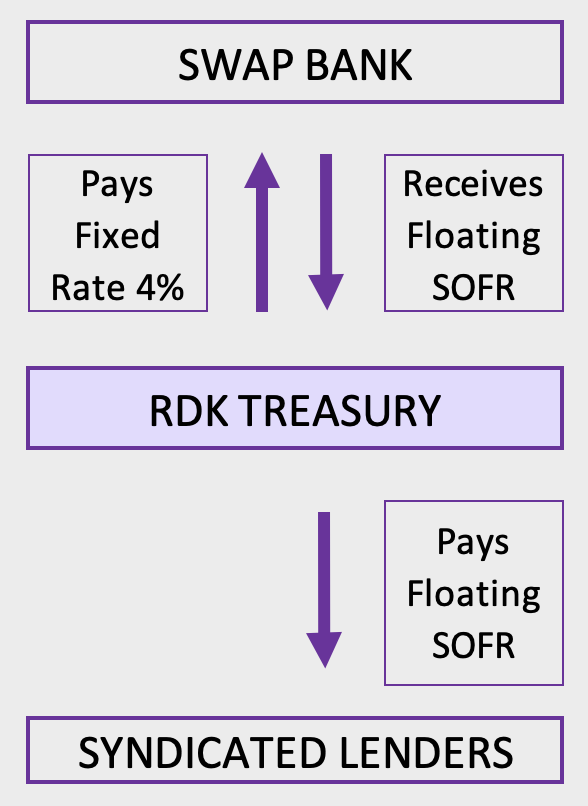
To hedge a floating-rate liability, the treasurer executes a Payer Swap, committing to pay the bank a fixed interest rate while receiving a floating interest rate (matching the loan's benchmark index, such as SOFR) from the bank.
When this derivative structure is layered on top of the floating loan, the mechanics self-neutralize: the floating rate received from the swap bank perfectly offsets the floating rate owed to the syndicated lenders. The corporation is left with a clean, predictable net cash outflow consisting of the fixed swap rate plus the original credit spread of the loan.
The Mathematics of Period Net Settlement
In practice, swap counterparties do not exchange full, gross interest payments. Instead, at the conclusion of each defined calculation period, the swap contract is audited, the payment obligations are offset, and a single Net Settlement Payment is executed.
The cash flow value of this periodic net settlement is governed by the following money-market formula:
Net Settlement Payment =
Notional Amount × (Fixed Swap Rate − Floating Benchmark Rate) × (Days/360Days)
Positive Result: If the negotiated Fixed Swap Rate exceeds the prevailing Floating Benchmark Rate, the equation yields a positive number, meaning the corporation must pay the net cash difference to the swap bank.
Negative Result: If the Floating Benchmark Rate spikes higher than the Fixed Swap Rate, the equation yields a negative number, indicating the swap bank must pay the net cash difference directly to the corporation.
Worked Corporate Scenario
To evaluate the mathematical proof of this immunization strategy, let us track a corporation that executes a $50,000,000Payer Swap with a fixed rate of 4.00%, structured to hedge a matching $50,000,000 floating syndicated loan priced at SOFR plus 2.00% over a 180-day interest calculation period.
Scenario A: The Macroeconomic Rate Spike: SOFR Climbs to 5.50%
If benchmark SOFR rises to 5.50%, the total rate owed to the underlying syndicated lenders becomes 7.50% (5.50%SOFR + 2.00% spread).
The gross cash payment owed to the lenders is calculated as:
Loan Payment = $50,000,000 × 7.5% × (360/180) = $1,875,000
Simultaneously, the derivative contract calculates the Net Swap Settlement:
Net Swap Settlement = $50,000,000 × (4%−5.5%) × (360/180)
Net Swap Settlement = $50,000,000 × (−1.5%) × 0.50 = −$375,000
Because the mathematical result is negative, the swap bank pays $375,000 directly to the corporation.
The blended net interest cost for the enterprise is calculated by aggregating the two cash flows:
Net Cash Outflow = Loan Payment + Net Swap Settlement
Net Cash Outflow = $1,875,000 + (−$375,000) = $1,500,000
On an annualized basis, this net outflow represents an exact borrowing cost of 6.00% (the 4.00% fixed swap rate plus the 2.00% credit spread). The external interest rate shock has been completely neutralized by the cash infusion from the derivative asset.
Scenario B: The Macroeconomic Rate Crash: SOFR Drops to 1.50%
Conversely, if benchmark SOFR declines to 1.50%, the total interest rate owed to the syndicated lenders drops to 3.50%(1.50% SOFR + 2.00% spread).
The gross cash payment owed to the lenders is calculated as:
Loan Payment = $50,000,000 × 3.5% × (360/180) = $875,000
Simultaneously, the derivative contract calculates the Net Swap Settlement:
Net Swap Settlement = $50,000,000 × (4%−1.5%) × (360/180)
Net Swap Settlement = $50,000,000 × (2.5%) × 0.50 = $625,000
Because the mathematical result is positive, the corporation must pay $625,000 to the swap bank.
The blended net interest cost for the enterprise is aggregated once again:
Net Cash Outflow = $875,000 + $625,000 = $1,500,000
Annualizing this cash outflow yields the exact same borrowing cost of 6.00%.
While the corporation missed out on the drop in financing costs on its floating debt, it achieved total balance sheet predictability. Regardless of whether macroeconomic benchmarks scale to extreme heights or contract toward zero, the enterprise's net cash outflow remains anchored, eliminating interest rate volatility from the operational runway.
5. Strategic Corporate Debt Principles
Navigating the modern debt capital markets effectively requires corporate treasury leaders to adhere to four core risk management principles:
Decouple Sourcing from Risk Management: Corporate issuers should source debt capital in the markets where liquidity is most abundant and credit spreads are tightest. Once funding is secured, the treasury team can use synthetic derivative overlays to transform the debt's profile to align with the company's internal risk tolerance.
Match Cash Flow Duration: The structural maturity of a company’s debt should align with the duration and cash-generation velocity of the underlying assets being funded. Short-term working capital needs should be funded via flexible rolling bank lines, while long-term infrastructure and capital expenditures should be financed via long-dated fixed bonds or swapped facilities.
Audit Counterparty Concentrations: Derivative overlays introduce systemic counterparty risk. If a swap provider bank faces an operational or credit collapse during a macroeconomic shock, the corporation’s underlying hedge could evaporate. Treasurers must actively diversify derivative placements across a highly rated network of financial institutions.
Enforce Absolute Hedging Discipline: Derivatives are precision tools designed to isolate and eliminate operational market variables. Using swaps or options to speculatively position a corporate balance sheet based on macroeconomic predictions transitions the treasury department from a center of risk mitigation into a source of enterprise vulnerability.
Our Corporate Treasury Fundamentals course covers debt markets, interest rate risk, hedging strategies and more — taught by practitioners with real-world corporate treasury experience.
👉 Enrol on Udemy HERE
